The proteiform graph itself is a polyhedron of scripture
Finnegans WakeThe proteiform graph itself is a polyhedron of scripture is the book’s image of writing as a many-sided, changing object rather than a transparent record of a single voice. Its signs carry traces of different hands, surfaces, and circumstances; their gaps and distortions invite interpretation without promising a final, stable text.
A document with many possible authors
The passage first imagines the graph as the trace of a “purely deliquescent recidivist,” perhaps ambidextrous, whose identity cannot be fixed by one bodily or biographical description. The writing seems to contain a “sexmosaic of nymphosis”: a crowd of sensations, appetites, and transformations compressed into one document. This plurality does not resolve into a clean portrait. Instead, the narrator suggests that many personalities have been impressed upon the document, while the changing minds and methods involved in making it have altered its words over time.
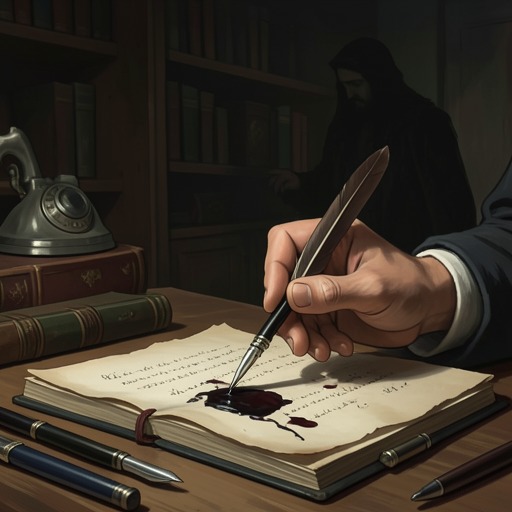
The question of authorship therefore remains open. The text asks who wrote the document, and imagines incompatible circumstances: its maker might be standing or seated, using a quill or stylus, working with a clear or clouded mind, interrupted by visitors or moving between places. The uncertainty is not merely biographical. If the hand could be one while the minds were many, the document’s apparent unity conceals a collaborative and unstable process.
Marks, damage, and material form
The graph’s meaning depends on its physical marks as much as on its words. Its lines run in different directions across ruled barriers; their crossing pattern is likened to a checker made with lampblack and blackthorn. Writing turns and doubles back, with lines moving end to end and then reversing direction. The page is not a neutral container: its orientation and layout help shape the act of reading.
The document has also accumulated material traces during its passage through time. Its surface may bear ink, stains, thumbprints, revisions, smudges, omissions, and misalignments. The narrator singles out Earwicker’s initials and a baffling emblem whose form changes with its orientation; other signs may stand for a person, accompany a name, or point toward a consort. These marks do not behave like a dependable code with one answer. They make interpretation a process of comparison, conjecture, and return.
Some features are explicitly uncertain or damaged: an incomplete trail, a dropped ending, and once-legible signs that have become illegible. A warning mark before the ancestral words permits them to be read in any order. That instruction turns disorder into a reading principle: a sequence need not be fixed before it can produce sound or sense, and rearrangement can bring those effects together again.
The work of interpretation
Readers approach the graph through rival explanations. Its strange traces may suggest crime before any occasion for a crime has occurred; under the inspectors’ closed eyes, opposing traits gather into one stable somebody. The same document can thus appear to forecast an accusation while also resisting the certainty of the investigators who would make it evidence. Interpretation shapes the identity it claims merely to discover.
A later episode dramatizes this problem through an unpunctuated document whose hidden marks become legible only under particular conditions. Held against a lit rush, its verso responds to light, while its other side reveals punctures and gashes made by a pronged instrument. Investigators interpret four kinds of wound as successive forms of a request to stop. The reading does not emerge from words alone: light, paper, perforation, and the observers’ inference combine to produce it.
A principle of the book’s language
The graph’s instability connects to the book’s wider language, in which blended words and altered spellings allow several associations to coexist. The opening evokes interrupted historical and familial narratives through compressed, transformed phrases; elsewhere, Jute and Mutt test each other with a succession of languages and accents. In the fable of the Ondt and the Gracehoper, Shaun announces an embedded tale through playful verbal distortion, while another speech shifts into mock pidgin. Across these different voices, language is heard and handled as mutable material rather than a fixed instrument.
Calling the graph a polyhedron of scripture makes that mutability structural: each face offers another angle, and no single view exhausts the object. Its damaged lettering, changing orientation, and competing readings do not simply conceal a recoverable original; they are among the conditions through which the book’s meanings take shape. The graph stands for a text that must be read actively, pieced together from marks whose relations remain open to revision.